
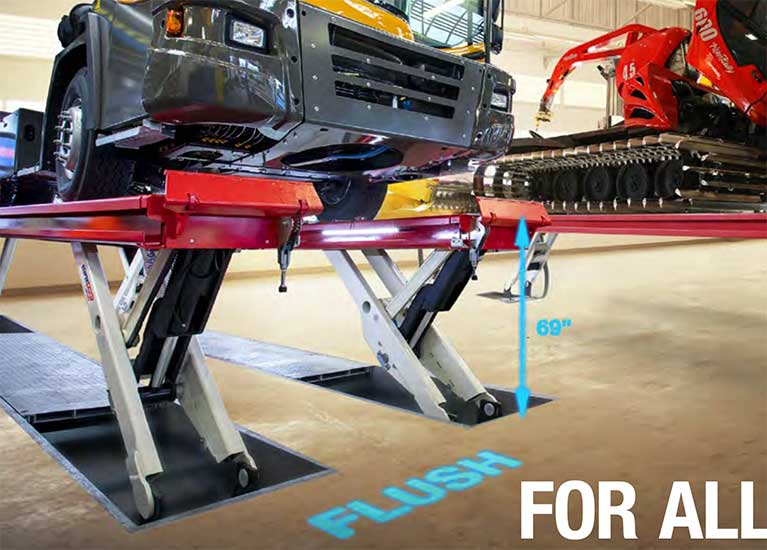
Some may have a hard time imagining needing to lift something heavier than 50,000lb but in reality, equipment and fleets in general have gotten heavier. Battery-electric buses, tandem-axle trucks and fully equipped emergency vehicles often weigh more than the vehicles an older lift was built for. You may have also increased your services to accommodate larger pieces of equipment. Whatever the reason, if you’re starting to get inquiries that exceed your current capabilities, it’s probably time to look at upgrading.
So what do you do? Well, at Hoffman we know what we do because we do it all the time but for others, this may be a first time! We have a 4 step guide that may offer a starting point at least.
1. Start with the vehicles, not the lift
Total capacity is only part of the picture. A lift is rated per piston, column or axle, so we looked at:
- The heaviest vehicle’s gross weight, plus each axle weight
- How the weight is split front to rear (buses and fire apparatus are often uneven)
- The range of wheelbases the lift has to cover
- How much the fleet is likely to grow
A lift must never be loaded past its rated capacity. Sizing it for the fleet you’ll run in five years avoids paying for a second upgrade.
For us, if you’re looking at a 78,000lb lift requirement, we’d look at the SKYLift 780 which is a drive-on-lift. We often prefer to replace like-for-like so a drive on to replace a drive on is perfect. Doesn’t always work that way so sometimes you have to be flexible.
2. Evaluate the site
A lift that holds more puts more load on the building, so the bay has to be checked first:
- In-ground lifts: pit size and depth, concrete condition, and whether the existing pit can take the new lift or needs to be rebuilt
- Mobile column and platform lifts: slab thickness and concrete strength checked against the manufacturer’s spec. Undersized slabs may need new footings.
- Clearances: ceiling height at full rise, plus room around the bay to work and drive vehicles in and out
- Utilities: electrical service (voltage and phase) and, if the lift needs it, compressed air
This is where you need to be able to determine what the site can actually do. Some cases, you’re going to need multiple mobile columns or pistons to be able to lift what you need to. Others can go drive-on. An expert would help you determine the best setup.
3. Remove the old lift responsibly
Taking out an older hydraulic lift means draining and disposing of its fluid, removing the old components and dealing with any contaminated material under local environmental rules.
4. Install and commission
The new lift went in according to the manufacturer’s instructions and the ANSI/ALI ALIS installation standard. Before handover, we would:
- Run a load test across the full height of travel
- Checked that the lifting points rise evenly (synchronization) and that the locks engage at every position
- Confirmed that adapters, jack stands and other accessories are rated for the higher capacity
That last check matters a lot. A 78,000 lb lift is only as strong as its weakest stand or adapter.
Look for a lift that is ALI certified to the ANSI/ALI ALCTV standard.
5. Train the operators and keep it inspected
A higher-capacity lift doesn’t change the basics, but crews should be retrained on the new controls, lifting points and locking positions. ANSI/ALI ALOIM requires an inspection at least once a year by a qualified inspector. Hoffman is an ALI Certified Lift Inspection Provider in New Jersey. See our lift safety and inspection guide.
View a video of one of our recent upgrade installs!